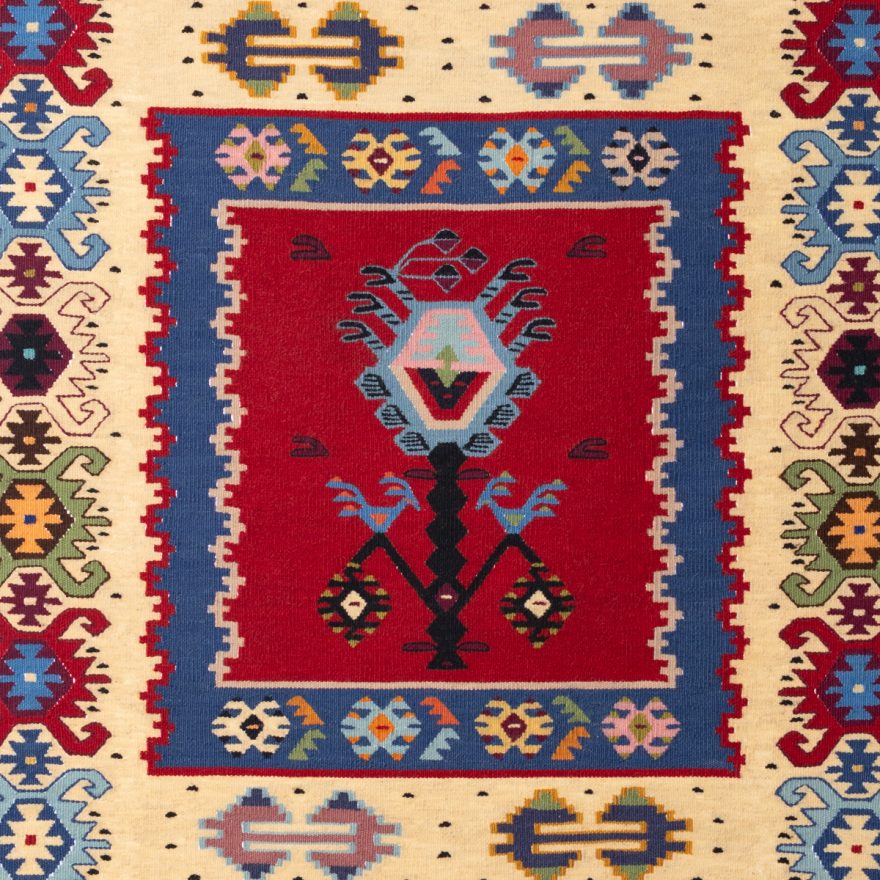
That is why Pirot kilim production is much more than simply working at a loom. It is a craft in which material, technique and the weaver’s experience come together in a unique object. For larger and more complex pieces, the process can take weeks or months, with every part of the pattern created during the weaving itself.
In this guide, we go through the entire process, from wool and yarn to the finished Pirot kilim. We explain what the warp and weft are, what a traditional vertical loom looks like, what warping and threading mean, how patterns are created, and what determines how long a kilim takes to make.
What Is a Pirot Kilim Made From?
The primary raw material for a traditional Pirot kilim is sheep’s wool. Wool from the Pramenka sheep holds a special place in Pirot kilim weaving, while selecting and sorting the fleece is the first important step in preparing the material.
Not every part of the fleece is used in the same way. Higher-quality wool suitable for further processing is selected, because the characteristics of the fibres affect the spinning process, yarn strength and the ability to create precise motifs.
Traditional descriptions of the production process state that a standard kilim measuring approximately 1.4 × 2 metres required wool from around nine sheep. As an illustration of the amount of raw material involved, around 100 kg of yarn could be obtained after processing approximately 300 kg of raw wool.
These figures should not be treated as a universal standard for every modern kilim. They primarily illustrate how much material and work are required before weaving even begins.
How Is Wool Prepared for a Pirot Kilim?
The journey from sheep’s fleece to yarn that a weaver can use on the loom consists of several stages. Traditional processing includes selecting and sorting the wool, washing, carding, spinning and preparing the yarn for dyeing and weaving.
- Selection and sorting: the higher-quality part of the fleece suitable for making yarn is separated.
- Washing: the wool is cleaned of impurities and natural oils.
- Carding: the fibres are separated and aligned.
- Spinning: the prepared fibres are turned into continuous yarn.
- Dyeing: the yarn receives the shades required for the particular composition.
- Preparation for weaving: the yarn intended for the warp and the yarn intended for the weft are determined.
Careful preparation is important because Pirot kilims feature highly precise geometric, vegetal and figurative motifs. The National Register of Intangible Cultural Heritage of Serbia describes Pirot kilim weaving as the skill of making woollen kilims on a vertical loom using the kneeling technique, with ornaments arranged within a central field and borders.

What Are the Warp and Weft?
To understand how a Pirot kilim is woven, it is first necessary to distinguish between the warp and the weft.
The warp is the system of longitudinal threads that forms the structure of the kilim. They are mounted on the loom and must be correctly positioned and tensioned.
The weft is the yarn passed horizontally through the warp. By inserting and beating down the weft, the surface of the kilim is formed, while different colours and thread arrangements create the motif.
Traditional descriptions of Pirot kilim weaving mention approximately 6–7 warp threads per centimetre and around 28 weft threads per centimetre. This weaving density is one of the reasons Pirot kilims have a compact and durable structure.
What Kind of Loom Is Used to Weave a Pirot Kilim?
Traditional Pirot kilim weaving uses a vertical loom and the kneeling technique. This is also one of the characteristics by which the craft is recognised in the National Register of Intangible Cultural Heritage of Serbia. Pirot kilim weaving was entered in the National Register on 18 June 2012.
The weaver sits low in front of the loom, while a multi-level bench may be used for larger pieces. As weaving progresses, the loom and working position allow the surface to be built gradually, section by section.
Traditional measurement was not always based on the modern metre. Descriptions of Pirot kilim weaving mention units such as the arshin (about 0.68 m), half an arshin (about 0.34 m), a quarter arshin (about 0.17 m), and half a quarter arshin (about 0.085 m).
This is a good example of how important precision and experience were even before modern measuring instruments.
How Is a Pirot Kilim Made Step by Step?
1. Warping – Preparing the Warp
Warping is the process of preparing the warp threads for the future kilim. Traditionally, a warping frame is used around which the threads are arranged and wound according to the planned width and length.
Traditional work involved coordinating several women. One person could lead the winding process while others helped maintain the correct arrangement of the threads. The goal is to create a warp that is even and precise enough for weaving.
A mistake made at this stage can affect the entire kilim, which is why warping is not merely preparation but an important part of the craft knowledge.
2. Preparing the Loom
Once the warp has been prepared, it is removed from the warping frame and mounted on the loom.
The traditional loom consists of vertical posts and elements that hold and tension the warp. Older descriptions of the Pirot loom mention the soje and krosna.
The warp must be correctly positioned, sufficiently tensioned and evenly distributed. The later progress of the weaving depends on it.
3. Threading and Forming the Shed
Threading is the process of organising the warp threads so that the even and odd threads can be separated to form the shed – the opening through which the weft passes.
At first glance this may seem like a technical detail, but without a properly prepared shed, weaving could not proceed in the correct sequence. This is therefore another part of the process that the weaver must master.
4. Inserting the Weft
The weft is wound onto a shuttle and passed between the warp threads. After the weft passes through, the threads are beaten down to create a dense and compact structure.
The process is repeated row by row. At the same time, the weaver must control the width, density, thread tension and colour arrangement.
5. Creating the Motifs
The most visually distinctive part of the production process begins when the patterns are built into the structure of the kilim.
A traditional Pirot kilim is not a product onto which a finished design is printed afterwards. The motif is created during the weaving itself, by arranging coloured threads.
The weaver must follow the composition while working: where the motif begins, how it repeats, where the colour changes, and how each element fits into the whole.
Pirot kilims feature geometric, vegetal and figurative ornaments. Examples include doves, reptiles, scorpions, beetles, branching trees, đulovi and wreaths.
For a detailed explanation of traditional motifs, see Pirot Kilim – Patterns, Meaning and Symbolism of Traditional Motifs.
6. Weaving as a Single Piece
One of the characteristics of a traditional Pirot kilim is that it is made as a single piece, without subsequently joining multiple separate sections.
This becomes particularly demanding with large dimensions. The weaver must maintain the width and rhythm of the composition as the kilim grows, while larger projects may be organised so that several weavers work in coordination.
Older descriptions state that several weavers could work on some larger kilims. However, it would not be correct to automatically assign the same number of weavers to every large kilim; the number depends on the particular project and organisation of the work.
7. Finishing
Once the main weaving is complete, the edges, thread ends and overall regularity of the kilim are checked.
Special attention is paid to the ćenar, the border that frames the central field. The ćenar is not merely decorative; it is an important part of the composition of a traditional Pirot kilim.

How Is the Pattern Created on a Pirot Kilim?
The pattern is built together with the fabric itself. This is one of the key differences between a hand-woven kilim and a product onto which a motif is applied after the surface has already been made.
The weaver must remember and follow the sequence of motifs, the relationships between colours and the proportions of individual elements. Complex compositions require considerable experience.
The National Register notes that patterns on older Pirot kilims are often smaller and more harmoniously arranged, while motifs on newer examples tend to be larger.
That is why the patterns are not merely decorative elements. They are part of the visual language of Pirot kilim weaving and one of the reasons the craft is recognisable at a glance.
How Long Does It Take to Make a Pirot Kilim?
There is no single production time that applies to every Pirot kilim. The time required depends on the dimensions, density, complexity of the pattern, number of colours, the weaver’s experience and the number of looms involved.
According to data from an earlier production description on Kilim.rs, a kilim with an area of approximately 7.2 m² requires around three months of work on three looms, with approximately 0.8 m² woven per loom per month.
This is a useful reference point, but it should not be treated as a universal formula. One piece may require more or less time depending on the particular pattern and organisation of the work.
In other words, when someone asks how long it takes to make a Pirot kilim, the most accurate answer is: from several weeks to several months, and even longer for large and complex pieces.
Why Does Hand-Weaving Take So Long?
The reason is not simply that everything is done without an industrial production line. The real challenge is the number of decisions the weaver makes throughout the process.
The weaver controls all of the following at the same time:
- warp tension;
- weft density;
- kilim width;
- colour sequence;
- motif shape;
- composition symmetry;
- finishing of individual sections.
With complex patterns, there is no room for carelessness. An error that is not noticed immediately may only become visible several rows later, when correcting it is much more difficult.
That is why a weaver’s experience cannot be reduced to speed. An experienced weaver knows how to maintain rhythm, recognise a problem in time and preserve the proportions of the motifs across the entire kilim.
What Is the Difference Between a Pirot Kilim and Other Balkan Kilims?
The Pirot kilim belongs to the broader tradition of Balkan hand-weaving, so there are similarities with other regional kilims. However, they should not be treated as the same product.
Pirot kilim weaving is characterised by a vertical loom, the kneeling technique, wool as the material and a distinctive system of ornaments. The National Register uses these characteristics in its description of Pirot kilim weaving.
Comparisons with Sjenica or Bosnian kilims can be interesting, but they are better suited to a dedicated comparative article than to this guide. Here, it is more important to understand what happens in the production of a Pirot kilim itself.

Why Is Pirot Kilim Weaving Part of Serbia’s Cultural Heritage?
Pirot kilim weaving has not survived merely as a collection of old objects. It represents knowledge and craftsmanship passed down through generations.
Pirot kilim weaving was entered in the National Register of Intangible Cultural Heritage of Serbia on 18 June 2012. The official register describes it as the skill of making woollen kilims on a vertical loom using the kneeling technique.
It is important to distinguish between the National Register of Serbia and the UNESCO list. Being entered in Serbia’s National Register does not mean that Pirot kilim weaving itself is entered on the UNESCO Representative List of the Intangible Cultural Heritage of Humanity. Serbia’s National Register is maintained by the Centre for Intangible Cultural Heritage at the Ethnographic Museum in Belgrade, while UNESCO inscriptions follow a separate international procedure.
This distinction matters because the simplified or inaccurate statement that the Pirot kilim is “protected by UNESCO” is often repeated online. It is more accurate to say that Pirot kilim weaving is entered in the National Register of Intangible Cultural Heritage of the Republic of Serbia.
How Is the Knowledge of Pirot Kilim Weaving Preserved Today?
Preserving a craft does not simply mean keeping old kilims in museums. It is much more important that the knowledge and techniques can continue to be passed on to new generations.
The Centre for Intangible Cultural Heritage of Serbia states that the goal of safeguarding is precisely to recognise, practise and transmit living heritage within communities.
For Pirot kilim weaving, this means preserving knowledge of wool, looms, weaving techniques and motifs, as well as the way the craft as a whole is passed from experienced weavers to new generations.
What Should a Buyer Know About Pirot Kilim Production?
Understanding the production process also helps when buying. Once you know how many steps are required to make a kilim, it becomes easier to understand why a hand-woven piece should not be compared with an industrial carpet solely by price per square metre.
Before buying, pay attention to:
- whether the kilim is genuinely hand-woven;
- what material it is made from;
- the density and regularity of the weaving;
- how the patterns are executed;
- the edges and ćenar;
- the exact dimensions;
- the provenance of the particular piece;
- whether it is new, antique or restored.
For a more detailed guide, see How to Choose a Pirot Kilim: Complete Buying Guide.
How Does Production Affect the Price of a Pirot Kilim?
The price of a hand-woven Pirot kilim does not depend only on its surface area. It reflects the material, labour time, complexity of the motifs, weaving density, dimensions, finishing, and, for older pieces, their condition and provenance.
That is why two kilims of similar size can have very different prices. A complex motif requiring extensive handwork is not equivalent to a simpler composition covering the same area.
Labour time is precisely one of the reasons why it is useful to understand the production process before comparing kilims.
From Production to the Finished Kilim
When all the stages are considered together, the process looks like this:
- selecting and sorting wool;
- washing and preparing the fibres;
- carding;
- spinning;
- dyeing and preparing the yarn;
- warping;
- mounting the warp on the loom;
- threading and forming the shed;
- inserting the weft;
- creating the pattern;
- beating down and controlling the weave;
- finishing and inspecting the completed kilim.
Each step depends on the previous one. If the material is not prepared properly, problems may appear during weaving. If the warp is not correctly mounted, the entire structure can be affected. If the motif is not followed precisely, the composition is disrupted.
This is the essence of the traditional craft: the finished kilim is the result of a large number of small, precise decisions.
Frequently Asked Questions About Pirot Kilim Production
How is a Pirot kilim made?
A Pirot kilim is traditionally made from wool yarn on a vertical loom using the kneeling technique. The process includes preparing the wool, spinning, preparing the warp, warping, setting up the loom, threading, weaving and creating the pattern.
How long does it take to make a Pirot kilim?
It can take from several weeks to several months. The time depends on the dimensions, pattern complexity, weaving density and organisation of the work.
How much wool is needed for a Pirot kilim?
The amount depends on the dimensions and characteristics of the particular piece. Traditional data state that a kilim measuring approximately 1.4 × 2 m required wool from around nine sheep.
What is warping?
Warping is the preparation and arrangement of the warp threads, which are then mounted on the loom. It is one of the key preparatory steps in production.
What is a vertical loom?
A vertical loom is a structure on which the warp is positioned upright and the kilim is gradually woven from the lower section upwards. Pirot kilim weaving is traditionally associated with the vertical loom and kneeling technique.
What is the kneeling technique?
It is a traditional way of working on a vertical loom characteristic of Pirot kilim weaving. The weaver works low in front of the loom and gradually builds the surface of the kilim.
What are the warp and weft?
The warp consists of longitudinal threads mounted on the loom, while the weft is the yarn passed horizontally through them and beaten down to form the fabric.
How are patterns created on a Pirot kilim?
Patterns are created during the weaving itself by arranging coloured threads. They are not subsequently printed onto the finished kilim.
Does a Pirot kilim have a front and back side?
The traditional flat-weaving technique allows the motif to be visible on both sides, so a Pirot kilim does not have a conventional front and back like many other carpets.
Why is a Pirot kilim so dense?
The density of the weave allows precise formation of motifs and contributes to the kilim’s firm and compact structure.
Can several weavers work on one kilim?
Yes. Several weavers can participate in larger projects, but the number depends on the size, organisation and specific project.
Is Pirot kilim weaving on the UNESCO list?
Pirot kilim weaving was entered in the National Register of Intangible Cultural Heritage of the Republic of Serbia on 18 June 2012. This is not the same as being inscribed on the UNESCO Representative List of the Intangible Cultural Heritage of Humanity.
Why is a hand-woven Pirot kilim more expensive than an industrial carpet?
Because the price reflects handwork, materials, production time, motif complexity and finishing. An industrial carpet and a hand-woven kilim are not the same type of product and should not be compared solely by price per square metre.
Conclusion: A Pirot Kilim Is a Process, Not Just a Finished Product
When we look at a finished Pirot kilim, it is easy to see only the colours, patterns and final appearance. Only after understanding its production does it become clear how much work lies behind a single woven surface.
From fleece and yarn, through warping and preparing the vertical loom, to threading, weft insertion and the careful creation of every motif, each step has its role. That is why Pirot kilim weaving is at once a craft, a skill and part of living cultural heritage.
If you would like to continue exploring the subject, read about patterns, meaning and symbolism of traditional motifs, explore the history of the Pirot kilim, or learn how to choose a Pirot kilim before buying.
To browse specific pieces, you can view Rasics pattern, Bombe or Kuvere as examples of different traditional motifs represented in actual products.